
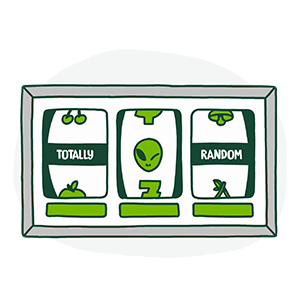
Slot machines generally have three or more “reels,” each of which has a number of symbols.
While physical slot machines may have 20 or more symbols per reel, digital technology allows them to have many more—some have 256 virtual symbols—with millions of possible combinations.
The combinations of symbols that pay out if you bet on them are called “paylines.”
Slot machines contain random number generators(RNG’s) that can generate thousands of numbers per second, each of which is associated with a different combination of symbols.
Whether you win or lose is determined by the random number generated in the exact instant you activate each play—if it matches a payline, you win.
Since each spin is independent, random and unrelated to previous or future spins, it’s impossible to predict what will happen on each play.
Nothing about a machine’s location, or the way you play, affects the outcome of a game. Slot machine wins and losses are always random, with no predictable pattern.
There are many different kinds of slot machines. Some allow you to choose how many paylines to bet on per play, and how much you want to bet. Before you put your money in, figure out the cost per play, the odds, the paylines, the return to player, and anything else that will help you make the right decisions for you. Look for pay tables on or near the machine that explain everything you need to know.
The possible payouts and the odds of winning depend on the machine you’re playing, the paylines you choose to play, and how many credits you wager.
Machines that cost pennies to play might pay out small prizes relatively often. Others cost several dollars per play, but offer bigger jackpots and higher odds.
No matter what machine you decide to play, the odds always favour the house. This means that over time, it’s more likely than not that you will walk away with less money than when you started.
Slot machines and Electronic Table Games (ETG’s) are meant to provide entertainment. Just like going out for dinner and a movie, you generally have an idea of what you plan to pay.
When you’ve spent your budgeted money, it’s time to call it a day. It’s a good idea to approach gambling the same way.
Avoid spending more time or money than you planned, set a budget for your casino visit, as well as a time limit.